Friday, March 18, 2011

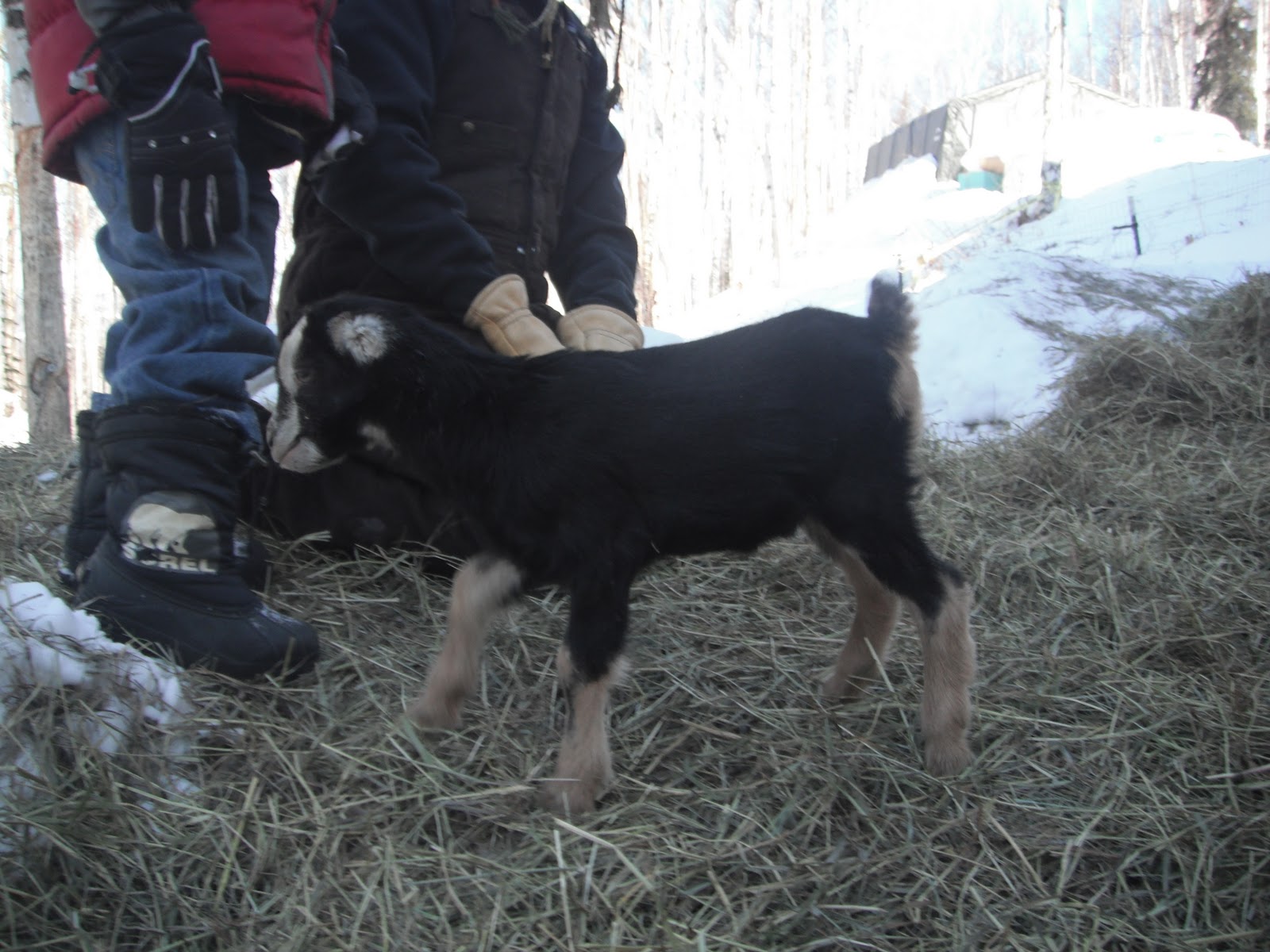
First trip outside for first goat kids


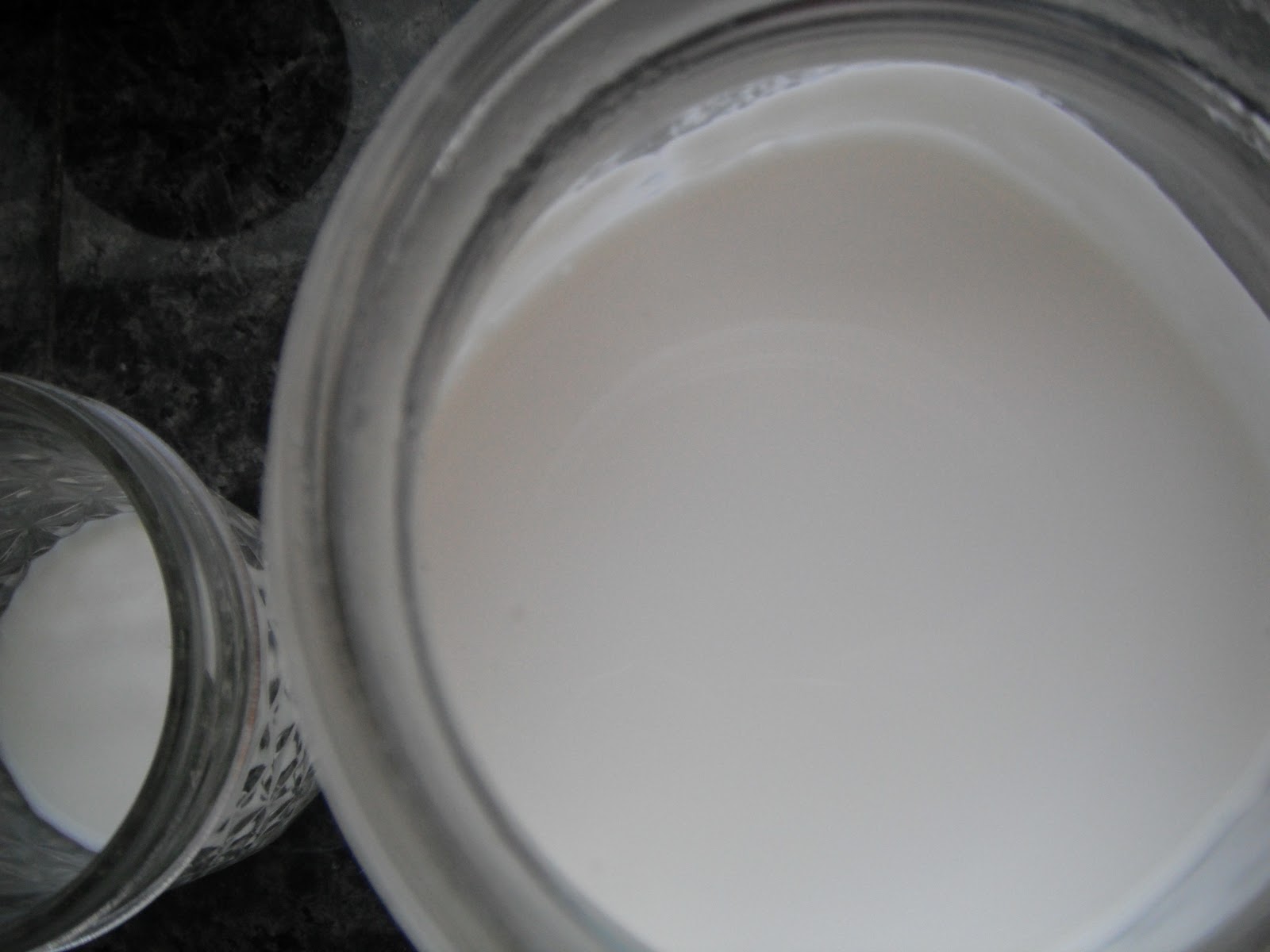
 And why we do it all; fresh unadulterated milk. I did a little taste test. We still had part of a gallon of organic cow milk from the store. So I poured each into an 8 oz glass jar. The goat milk was clean tasting, creamy and rich, no trace of goatiness or too sweet, it was perfect. The cow milk on the other hand, had a bit of an odor and tasted kind of weak and overly sweet. To be fair, it was nearing the expiration date. There was no comparison, the goat milk won hands down, and the rest of the cow milk went to the chickens. Hopefully we won't have to buy milk for a very long time.

Thursday, March 17, 2011

A sad loss, followed by Zinnia's triumphant kidding

On Monday night we lost our little cream colored doeling. She had been very weak since her birth. I kept hoping if I could squirt enough milk down her throat she would perk up. I had thought that she just needed milk and rest and was overly weak from being cold and wet for too long. I don't know if maybe there was something else wrong as well. In the evening it seemed like she was getting weaker so I decided to bring her indoors for the night so I could keep a closer eye on her and feed her frequently with the drenching syringe. I gathered some supplies and waited for my kids to go to bed before bringing her inside. I went out to get her about an hour later and she was dead.

We don't take goat deaths lightly. I have never experienced much death. I use to cry when we'd lose a chicken. Now, several chicken, duck, and goat deaths later, well, I don't cry over chickens anymore. Goats are a different matter. I was very sad. Frustrated with myself for not bringing her indoors sooner. This is Roses fourth kidding season, second doeling and the first doeling we've had that wasn't black and tan, and our first doeling out of Zoro. We were all pretty excited to have a pretty little buff doeling. More lessons learned and taken to heart. Be there for kidding, get the milk and colostrum in to them immediately, pay close attention to them, and if they are not doing well; take action. I should have brought her indoors first thing, kept her warm and fed her by hand.

On a lighter note, Roses other two kids are doing great. They are very spunky and friendly. We've named the buckling Briar, Wild Roots Briar to be exact, and the black and white doeling is named Wild Roots Bramble Rose. We have a deposit for Briar and will be registering him as a buckling. I disbudded Briar today, the first time I have done it by myself. In the past we have taken the kids across town to have them done. Last season I decided it was time to step up and learn how, as unpleasant a job it is. I was dreading doing it, but it feels good to be able to do a good job myself. I think he has already forgiven me.

Zinnia, Roses first daughter kidded on Wednesday morning, after a very long labor. We noticed she was in labor Tuesday evening. She was in early labor but was progressing into consistent obvious contractions. I started sitting with her around nine p.m. thinking she might kid within a few hours and hoping my presence would be reassuring. Becca joined me shortly thereafter and we began a long night. Her labor progressed until she was just beginning to almost push, and then she started dosing off. I thought maybe I better see what was going on, but she was very energetic still, not distressed, and wanted nothing to do with my inspection. So we decided to wait and see if she could do it on her own. 

Deciding if she was actually in active labor was the key issue. I decided that she hadn't really gotten there and being a first timer, it must just be taking her a while dilate. She started dozing off and so did we. At six a.m. we came in to warm up and watch her on the goat cam. We decided to go to bed, but not before waking up Dustin and putting him on goat watching duty. After a couple hours of sleep, we headed back out. She hadn't progressed. I had been worrying all night that the kids weren't in the correct position and that is why it was taking so long. It is always a tough decision deciding whether to "go in", not wanting to jump the gun when unnecessary, but not wanting to wait until it is too late and be pulling out dead kids.

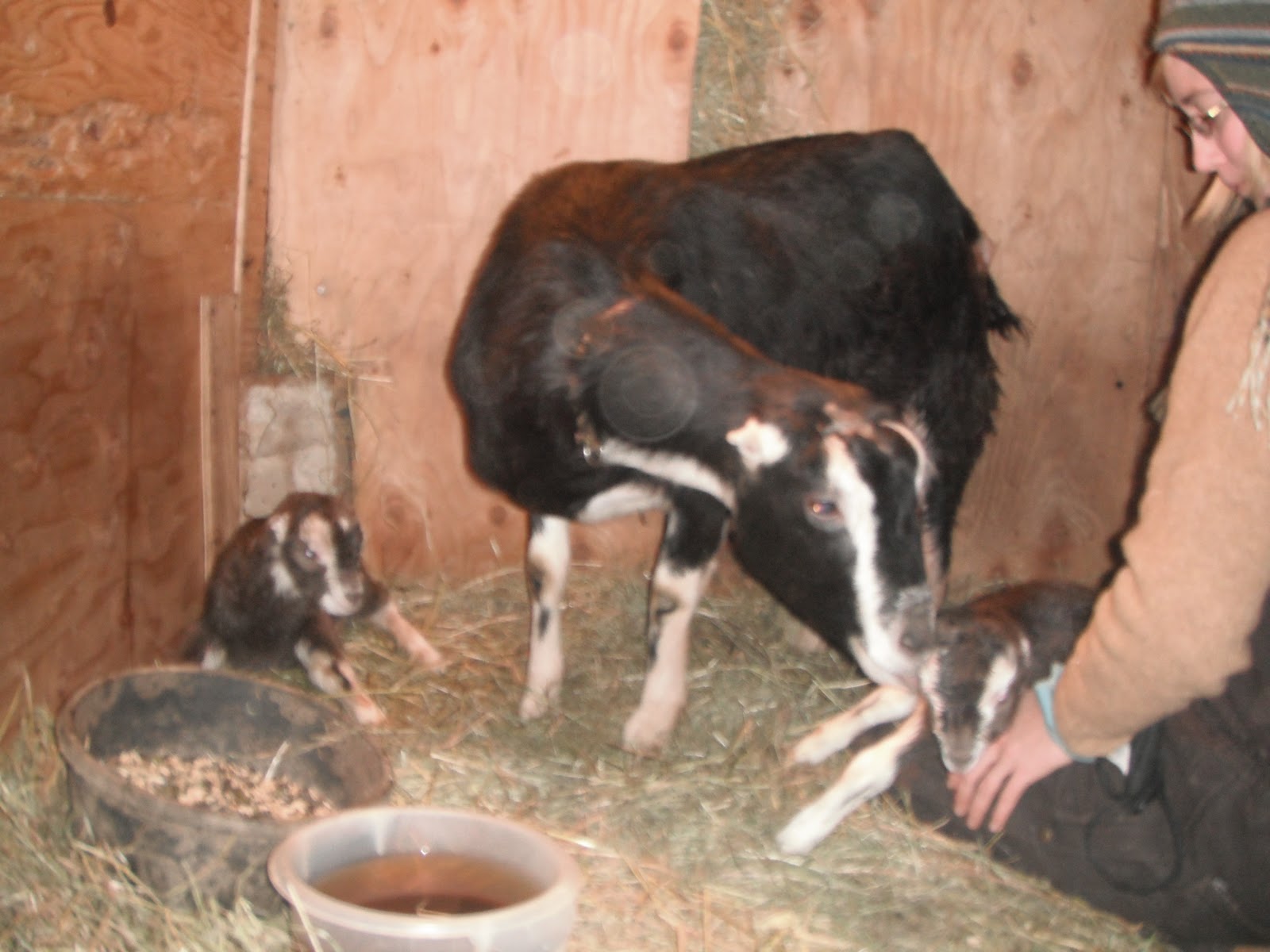
By late morning I decided it was time. Zinnia was still having contractions, dozing in between, and every once in a while giving a light push, but nothing was progressing. Becca held her in a corner, I lubed up and slowly went in, one finger at a time. The kids were pretty far in, so not close to coming out. I grabbed ahold of two hooves. I thought they were the front hooves but upside down, but I wasn't sure if I was feeling a nose or a sack of fluid. Turns out I had the back feet, the kid was backwards. Zinnia pushed and I pulled, pausing in between contractions. Finally we had her out. As much pain as Zinnia was in, she was enthusiastic from the get go about her new baby girl. The second kid wasn't far behind. Soon we saw a bubble, and then a head, a fairly large head. I debated for a minute whether she could push this kid out on her own as her mother had doe earlier this week. But this baby was bigger, and this was Zins first time. So I put on a fresh glove and went back in. I got her left leg out, but the right one was pretty far back. She gave a push and I was able to pull the kid out with just one leg. Another doeling!


 We spent a lot of time looking at this end of Zinnia.


First doeling out.


 Second doeling out!
 I'm wiping all the slime off, especially around her nostrils and mouth so she can breathe.

 We go through a roll of paper towels per birth just getting the slime off and drying them off. Once they are somewhat dry I finish up with old cloth towels.


Zinnia is extremely attentive over her daughters. She was not interested in her grain, molasses water, hay or eating her placenta. She turned to nip at Becca and I several times when her doelings would cry out as we were trying to get them to nurse. I've never had a doe this protective over her kids. The doelings are big and strong. We weighed them today, one was seven and three quarters and the other eight and three quarters pounds. They were standing on their own within minutes, and nursing on their own within a few hours. I haven't had to help them find teats or angle the teats for them at all, as I often have to do. Part of it is that her teats are small and higher up which helps their little mouths grab on easier. This is our first new mama in a while. I am relieved that she is doing such a great job with little assistance. She may have delivered them on her own, but it would have been a lot later in the day. I am giving her an immune support tincture twice a day, which will help with the inflammation, pain and prevent infection. The new family look like they are doing just fine. We are thinking Belladonna (Bella) and Bryona, (Bree).

Monday, March 14, 2011

Rose is Hero of the day

Noah looking up at Rose.

After Rose kidded, Noah asked if Rose is a hero. Having experienced natural childbirth myself firsthand, although never triplets and all by myself) I replied: Rose is certainly a hero, the hero of the day.
 
We checked on the does last night before going to bed, then again around 4 a.m., 7a.m. and finally came downstairs around 8:30. If I had watched for ten minutes instead of two, I probably would have noticed the contractions, but as I didn't we had a surprise waiting for us as we got up. Avery and I sat on the couch looking at Rose on the goat cam. Every time I turned on the cam/tv last night Rose was standing still, looking like she was sleeping on her feet. I thought we'd better watch her for a while before turning on Sesame Street. As we sat and watched Rose, she leaned forward and started pushing, and a black blob shot out. I yelled up to Dustin and raced to get my clothes on and get down to the doe stall. As I entered, Rose was licking the new baby. I saw that there was a buff/light red kid against the wall in a pile of goop (the back wall is just out of range of the camera). This is the first kidding we weren't waiting with hands outstretched to catch the kid as it came out. The buff kid on the floor was cold and wet. I immediately piled both kids next to each other and started wiping off the goop and drying the kids off. The buff one was trying to stand and nurse but Rose was getting ready to push another kid out. 

As Rose started pushing a good size head pops out, dangit. I debate whether to see if she can push it out or go grab some lube and gloves. I race into the house in a frenzy, impatient as D draws a bowl of warm water for me. Then I race down the slippery slope to the milk area and grab gloves and sprinkle some lubricant powder into the water. As I enter the kidding stall, I see Rose on her side, legs flailing in the air, her two kids near her belly about to get squished, and another buff wet kid sprawled out behind her.

Dustin was inside watching. He said that Rose gave such a big push that she fell over sideways and he thought that she was going to fall on her first two kids. This is the first time that we've had a goat deliver a kid head first. After the first year of having a kid get stuck there for hours till the vet showed up, we go right in for the legs when a head presents first. 

After all the kids are dried off, we work on making sure everyone gets several good sucks and nurses until they aren't interested anymore. I took Rose warm molasses water, grain and fresh hay. We let Rose eat her afterbirth as it is full of vitamins and minerals- and she gobbled it down. The first doeling is weaker than she should be. She still hasn't had the strength to stand up and nurse on her own. So I have been holding her mouth open while I squirt milk down her throat. She weakly swallows, but has a strong cry. We are going to keep a close eye on her and continue getting the milk into her.

Rose has been great, caring for her kids, licking and cleaning them, standing still why they bumble about looking for the source of nourishment. This is her fourth kidding, one buck her first year, one doeling/one buck her second year, three bucklings last year, and this year: two doelings and a buckling - Yeah! We've been tossing around Briar and Bramble for the doelings. But nothing set yet. We will most likely sell the black and white doeling. We will to wait until some more kids are born, but I would love to keep a light red doeling out of Rose and Xoro. 

Good job Rose, you are my hero today.


First goat kid pics


story coming

Saturday, March 12, 2011

March kids and goats

The daylight is waking us up around seven a.m. The sun is pouring into the house all afternoon and into the evening. It is so bright outside, that I've been needing sunglasses on while outside doing afternoon chores. The kids and I have been getting out most afternoons for a walk. We've been choosing a select few goats to come along as well. Two does get left out as they've taken to butting Avery and Noah when given the opportunity. Rose and now Zinnia are getting left behind because they are too uncomfortably pregnant, and while I thought a walk would still be good for them, Zinnia complained, bawled the whole way on her last walk- poor thing.

Avery got this new snowsuit - Thankyou Grandma! As you can see it is cute if a little impractical. Avery is getting opinionated about what she wants to wear these days. She is into pink, purple and pockets. I do not recall Noah being choosy about his clothes when he was two.

Noah has been enjoying the freedom of walking on top of the snow, venturing away from the driveway and trails. We had some serious winds a while back that seemed to compress the snow.


This is Zinnia on her last walk for a while. She has two due dates, as I bred her once and then she continued to act like she was in heat for the following week, so I re-bred her six days later. The due date I put on the calender for the goats is 150 days from when they are bred. They tend to kid a few days earlier. Zinnia's first due date was this Friday, so we started checking on her at night and throughout the day last Monday. Of course, once you start watching goats constantly, they act totally suspicious and like they are about to go into labor at any moment - at least the first doe of the season does- most likely I'm just overly jumpy. Zinnia is so uncomfortable right now, she paces, paws at the ground, nudges and nips at her belly, scratches her head with her back hoof, paws some more. Then when she tries to lay down she stops half way so she is sitting on her hind haunches unsure of how to lower herself down any further, before rising and pacing some more. She shifts her weight, grunts, huffs and begins chewing her cud again, but only after staring off as though she is closely paying attention to something internal, eyes glazing over as I wonder if she is having an early labor contraction - nope.

Zinnia is either at day 151, or more likely, day 145. She and her mom are in their own stall and pen. We can monitor them on the "goat cam" which is a security camera in their stall which is wired to our TV. This makes late night checks oh so much easier. I just get out of bed, turn on the TV, watch for a few minutes and go back to bed, rather than getting dressed in under and outer layers, boots, gloves, hat and headlamp to trek down that slippery slope and disturbing a bunch of sleeping goats. We've been going to bed and getting up early. Last night the alarm went off too many times, I think every 4-5 hours should suffice. Although, when the overly pregnant goat is pacing late at night instead of sleeping, you've got to wonder if she knows something you don't.


This is Zuri. Hard to believe that she is due in just two weeks, but she is! Her udder is just starting to take shape. So far she is keeping up with the un-bred doelings, running, jumping, letting them know she is still boss. Yesterday I moved three does up to our extra top pen, reserved for breeding and this time of year, when we need to weed out any extras who aren't close to kidding. So Xoe, who is bred but not due till May, and her daughter'sYin and Asia are up next to the bucks and not too happy about the arrangement, but everyone else is. Now, Zuri and Xan, the next does due, won't be picked on. The doe pen is peaceful and calm, for the moment.

Thursday, March 3, 2011

Is it spring yet?

I am ready for spring! There was one morning last week, where I stepped outside and the air was warmer than I expected, (above zero) and I could almost smell soil, dirt, the ground that is buried way down there somewhere. I thought, spring! I forget about the absence of scents outdoors in the winter. The farm doesn't smell, not when everything is frozen. I dreamed that I was hearing the songs that the chickadees sing only on spring mornings. We are gaining around seven minutes of light each day. Each morning I am surprised at how early it is light out. At evening I find myself looking at the clock and thinking; is it really this late? Shouldn't it be dark by now?

Yesterday as I drove into town the sun was so high and intense. The warmth seeped into my skin. I had to put my sunglasses on. Everywhere was sun. Sun glaring off the shiny metal buildings and white snow banks. The roads are icy and slick. I thought, isn't this what spring is - in Fairbanks?

I'm watching the goats belly's grow heavy and thick with kids, their udders filling with milk. I looked back at last years posts on goat kids this morning. Spring is: goat babies, collecting eggs for setting, bags of seedling mix and tinier bags of seeds, the smells of thawing manure, a warm day followed by a cold one and the sun; most importantly, the sun, full of promise and certainty.

Tuesday, March 1, 2011

Why Lamanchas?

When I first started looking into goats, I discovered that one of my co-worker's partners had been a large breed veterinarian in California.(She still is, but at the time was not working as such). Once I told her I was thinking of getting dairy goats, we began an ongoing dialogue that continued over the months. I was working in a kitchen atmosphere, so as we baked and cooked, we talked. It was common for friends to stop in for a muffin or a bite of something, and visit a bit. My main questions at the time surrounded what breed to get. She told me that of all the dairy goat breeds, Lamanchas were here favorite and that is what she would get if she were to start her own herd which she intended to do some day. Her main reason was personality. In her opinion they had an easy going, friendly disposition, that endeared her to this particular breed more than others. I have very little experience with other goat breeds, so I cannot say if Lamanchas seem friendlier than other goats. I have a feeling that all well loved and cared for goats can be loving and friendly with their owners. However, it was this bit of insight, early on in my quest for goats that first steered me in the direction of Lamanchas.

As I begin to research online, Molly's Fiasco Farm site was a wealth of information. Her goat herd consisted solely of Lamanchas. Her heard was beautiful. Her goats coats were short and shiny (as ours only look in late summer). They were all different colors, ebony, shades of rich browns, whites, creams and light reds, buff and butterscotch, added to this they had various white stars, strips, splashes and belts. I am very partial to variety in coat colors and markings.

What about their lack of ears? Well, I suppose that just by looking at so many pictures of Lamanchas online, I grew quite accustomed to their lack of large ears, and then when I would see a goat with large ears, I would be surprised, oh yeah, that's right, some goats have ears that stand straight up and stick way out, or flop and hang way down. I like large ears, they add personality. However, I also find that there is something very graceful and streamlined about the lack of large ears that I find very smooth and pleasing to look at. Some people can't get past the lack of ears. It doesn't bother me, nor was it a major factor in why I chose Lamanchas. I have heard that Lamanchas should be more hardy, as their ears won't freeze. In response to this, I would say that I'd hope the goat has the sense to go indoors if it is that cold out. Or, I wouldn't be doing my job if I didn't provide them with a warm enough and large enough area that all the goats were able to escape from the cold in.

I prefer full sized goats to miniature breeds. I owned a horse for eleven years, she was 15.3 hands, a good sized quarter horse. We have a large dog, full sized chickens. The cuteness of miniature breeds has never appealed to me as it does to some. Miniature breeds often look more stocky and stout. I enjoy the gracefulness that longer legs and height give. Entirely personal preference. And the thought of milking those tiny teats is not appealing. Last night I was dreaming of milking our first fresheners, and grasping those new little teats, after growing use to nice large teats that my entire hand comfortably fits around, I've gotten spoiled, not milking first timers in a while.

As far as milk quality and butterfat go, I've read that Nubians have higher butterfat. There are other subtle differences in milk properties between dairy breeds, but nothing significant enough to point me in a different direction. I am still smitten by Nubians, their floppy ears and high butterfat are tempting. I have heard that they are nosier, I haven't been around any to know if this is true or not. I think that someday we may have a couple Nubians, but not for a while - and I'll have to hang out with some first and see if the stories are true.

The dairy breeds most common in the interior are Toggenburgs, Saanans, Boers and Nigerian Dwarfs. I suppose I figured that if we were going to bring goats in from out of state, might as well bring in something different. It seems as though Lamanchas have been increasing in popularity over the last several years. There are quite a few now in southern Alaska.

I am convinced that as people become more educated and aware of our current food situation; the lack of "real" food, the over processing and killing off of the beneficial nutrients, vitamins, enzymes and even healthy bacteria that our bodies need, the demand to have control over what we put into our bodies, the desire to put real food, real milk into our bodies, will result in a demand and appreciation for dairy goats and cows. Demand for quality milking animals can only go up, especially here in interior Alaska, where we are at the very end of the supply line, so far removed and so easily cut off from our food sources.

So here's to dairy goats whichever breed you raise or decide to raise!!!