Showing posts with label seed starting. Show all posts

Wednesday, March 21, 2012

Not spring here yet


It has been a while since I've shared some pictures. Computer woes. Here are a few from the last couple months.


Sitting in the sun in front of the woodstove.

We took a family road trip to the nearest city, Anchorage, about four hundred miles south. Enjoyed being closer to the mountains.


We are all planning our gardens. Noah is excited about growing Watermelon, potatoes, carrots, thyme and flowers. Avery is planning on growing Watermelon, beets, broccoli, carrots and also lots of flowers. So far I have herbs and celery germinating. It is almost time to sow tomato and pepper seed along with some flowers. If you start your tomatoes too early they get leggy and root bound and don't take off as quickly when planted out. I think one of the biggest mistakes Alaskan gardeners make is not knowing when to start what. I was over at someones house the other day and they had cucumbers and squash already sown in six pack holders. That won't do folks! If you are a new gardener or don't have experience gardening here, pick up the Alaskan Growers Guide, or a seed starting schedule from your local Nursery. Also, visit your local Cooperative Extension and pick up a wealth of information for your area.


Doesn't feel like Spring here, but none the less, Happy Spring Everyone!

Sunday, March 4, 2012

Starting seeds and poultry decisions

I set up the seedling rack yesterday. Wiped and scrubbed the racks and shop lights. Moved shelves to the appropriate level. Hung lights. Moved into south facing windows. I was planning on digging through the snow for old plastic trays, domes and six pack holders - you'd think by now I'd store them in a more accessible location...I know they're around somewhere and I'll end up recycling most of them yet this spring. D surprised me with some shiny new trays, packs, domes and a large bag of seed starting mix last night. Perfect timing. So, if the day goes smoothly, I'm hoping to sow the first seedlings of the season today. I will be starting celery (Utah red heirloom if I remember correctly), summer and winter thyme, lavender, oregano and maybe some basil. It is early for the basil, but I love to start a few and transplant them into roomy pots and snip basil throughout the spring. I'll succession start it at least two more times before planting out. Next I'll start any other slow growing (ten week) flowers/herbs. Then peppers, tomatoes and eggplant the last week of March/first week of April - about eight weeks before I plan on planting in the ground.

I started tackling our hallway yesterday, making room for a small incubator and a chick brooder. I've been making some poultry decisions with the idea to keep things simple. As much as I love having turkeys around and in the freezer, I'm planning on abstaining from turkey poults this year. The plan is to trade a friend some of our laying ducks for a heritage turkey come fall. We will be eliminating the ducks as we need room. We are going to hatch some goslings for the summer but we are either just going to have our current goose pair, or maybe just two females next winter... Furthermore, we are going to raise less Cornish Cross, 15-20. We are going to get more strict about not keeping older layers around. So we will be butchering or selling the two year old hens to make room for the more productive ladies. 


Living on a steep hillside and having a small amount of flat land, makes it difficult to have large animal pens. Thus we have ended up with a few movable chicken tractors of various sizes. We have two (three in the summer) protected chicken coop/pens. When chicks and turkeys are overcrowded there are more losses. In addition, Cornish cross grow faster than layers. Ducks and turkeys all grow at different paces. So, while I have read about people raising all various species in the same pen with success - I find that the layers do better on their own as do the ducks and turkeys. There is less crowding, less stress, less bullying and fighting. As a result we have ended up raising four turkeys in one moveable coop, pullets or ducklings in another tractor, adult layers in the top coop, and ducks or growing pullets in the other two. This makes for lots of juggling of birds, multiple feed/water stops to make each day =more labor and time. 


This year I am hoping to swing into the feed store and pick up thirty to forty sexed laying chicks at one time. I'll pick up meat birds a few weeks later. The laying pullets should all fit into the bottom chicken coop/pen for the summer. The Cornish will go into our largest moveable tractor. I've yet to figure out what to do with the geese. I think they'll go into another moveable tractor, but be let out to roam if they can behave themselves. So, we still end up having birds in four locations. However the Cornish are short lived. The geese possibly temporary. Leaving us with two pens and lots of productive layers going into winter.

I am interested in dual purpose breeds. Breeds that handle confinement well. Gentle, docile, friendly breeds. They also need to lay fairly well. And I want the hens to be big enough to be worth butchering, five to six pounds. Cold hardy and laying well in winter are other obvious considerations. I do like pretty birds, colorful feathers, kind faces. I am also drawn to heritage breeds. I am in love with the idea of raising hens that were common one or two hundred years ago. 

In the past I've ordered birds through various hatcheries. It tends to be more expensive and risky. This year I decided to go through our feed store exclusively and let them take the risk for me. They have a special order list that peaked my interest but when I looked up the specific breeds at the hatchery, all the birds I was interested in are already sold out. I'll remember to order in December next year! So, working with what our feed store will be bringing in, This is what I plan on getting and what I've read about them;
  1. Silver Wyandottes,  four eggs/wk, 200 eggs a year. Handle confinement well. Hardy. Dual purpose, easy going temperament, good winter layers. Pretty.
  2. Delawares, four eggs/wk, large brown eggs. Heavy breed, matures quickly, good broiler. Quiet, friendly, adapts well to confinement. 
  3. Welsummers, decent layers of lovely dark brown eggs. Gentle, sweet, handles confinement well. Lovely plumage. 6lb. females.  (although shorter laying season).
  4. Ameraucanas, lay beautiful blue and green eggs. I find these birds to be a bit flighty, small in carcass size and to have a shorter laying season and to mature slowly. However, their lovely eggs make up for their shortcomings. 
  5. Black Sex Links, these are not heritage. However, these have been our best layers over the last four years. They are gentle, mellow, friendly birds who mature quickly and lay large brown eggs through the winter.
If I were to special order some birds, I would be getting some Sussex hens which are a heritage dual purpose breed, decent table fowl and very productive, nice disposition. I would also get at least a few Leghorns. Our feed store is carrying Chanteclers which I am not planning on getting because although they are good hardy winter layers that may not even need supplemental light, I've read they do not handle winter confinement well. These birds have a hawkish aggressive look to them. I would be interested in hearing from people who have experience with Chanteclers. We have raised Brahmas who are a large hardy bird. They are also very gentle and handle confinement well. They just didn't lay real well. I felt like we got a couple eggs from each hen their first year. They were by far the hardiest birds who would be outside in the cold when everyone else was huddled inside. A quick word on foraging. With the exception of the Cornish Cross, I have yet to see a chicken who was not an active forager. So, I think good foragers is a given regardless of the breed you choose.


On side notes, our friends who raised a pig for us two years ago in exchange for buck service for their does, have decided to do so again for us. So, yeah pig and not having to keep one ourselves - yet. I think I've finally figured out a better location for my bees, our unused greenhouse in the trees. We have a greenhouse that was built above our buck stall (once upon a time prospective Sauna). My plan is to take out a south facing window and set the hive up against the opening. That way the bees flight path will be above our heads, but they will be in a prime sunny warm location. We have two very pregnant does due the first week of April. I am getting excited. Thinking of C names, Clary, Calla Lilly, Calypso, Camelot, Cleopatra... I've been reading an awesome book - must have for all goat owners; The Accessible Pet, Equine and Livestock Herbal, by Katherine Drovdahl )Fir Meadow. I'm planning on sharing some of what I've been reading soon. Happy Spring everyone!

Friday, February 4, 2011

Garden Planning


I'm finally getting serious about garden planning, now that seed starting is just weeks away. Over the last few years I've gotten better at starting most seeds about the right time, not so early that they grow too leggy or root bound and not so late that they never amount to much. I set up a tall metal rack with five shelves, two sets of four foot long flourescents hanging above each level. I can fit four trays on each level. By the end of spring, some plants have moved outside to harden off in the greenhouse and there is room for a few more trays. Fortunately my husband sees seeds as food security. Therefor I am encouraged to invest in seeds. The last couple years I could have gotten away without ordering seeds as we have such a stock pile - but where is the fun in that?

Each year I greet the seed catalogs with much anticipation. Barbara Kingsolver writes in Animal, Vegetable, Miracle, (and I paraphrase from memory); "that she gazes at seed catalogs with the same misty eyed adoration as some women shop for diamonds." I looked for my copy so I could find the quote, as I do not do it justice. I remember reading that and thinking, she and I were kindred spirits as her words sum up my seed catalog fetish pefectly. I usually wait for a dull January afternoon before beginning to work my way through them, carefully taking notes. Over the course of a couple weeks I narrow my orders down to two or three catalogs.

This year I've deviated from my norm. I flipped through a couple catalogs and didn't see too much new. So I closely examined the Fedco catalog and have my order ready to place - today hopefully. I'm planning on ordering just from Fedco, so I haven't let myself even open up Territorial or Pine Tree. The greatest temptations will be when Seeds Of Change and Seed Savers come in the mail. They always have great pictures of something unique like hardy quinuoa or some beautiful South American root vegetable I've never heard of.

Some of the vegetable and flower seeds I've been tempted to try for the first time are Fava Beans, Scarlet Runner Beans, Celeriac, Arnica and Lemongrass. Some varieties I'm trying for the first time are Root Grex Beet, Honey Drop cherry tomato, Melissa Savoy cabbage, Charming Snow Cauliflower, and some different colors of Statice, Strawflowers, and lots of sweet peas, always. I've ordered Scarlett Keeper carrot for the first time in addition to Yellowstone, Atomic Red, Purple Haze and White Satin, all carrots I've grown that I was low on.

I did not allow myself to order any more radishes, turnips, green beans, peas, greens or broccoli - as I have enough seed for the next several years. Nor did I order any cover crops as I've done the last couple years. I'm going to see what comes back and just observe this year.

I am growing twice as many beets, carrots and shelling peas this year.The same amount of broccoli and green beans. More cauliflower, cabbage and squash. Less turnips, radishes and rutabagas. No corn! Less bitter greens and chard, more tender mild head and cutting lettuce.  Less full sized tomatoes, and more snacking cherry tomatoes. No leeks or shallots and less onions. Last year I planted over six hundred onion sets. We will be cooking with out own onions through March. As much as I enjoy this, the onions just took up too much garden space - and onions aren't expensive nor are my homegrown onions remarkable in their superior quality, so... I'm ordering two hundred Stuttgarter onion sets. I know it won't be enough to get us to this time of year but there will be more room for other crops. Like, I want a large lusty squash bed. I need to focus on starting medicinal herbs and making sure I plant them in prime locations. I have a habit of forgetting what medicinal herbs I've planted and what it was I was going to do with them. I never got around to harvesting Comfrey, Spilanthes or the Elecampane I grew last summer.

I'll be starting some herbs in the next week or so, followed by tomatoes, then peppers, eggplant and slow growing flowers. Time to set up that rack. What are you most looking forward to growing this year? What can't you live without? What is new?

Sunday, April 25, 2010

Setting eggs, seed starting, kids nursing lopsided and first milking

Tulips from my son

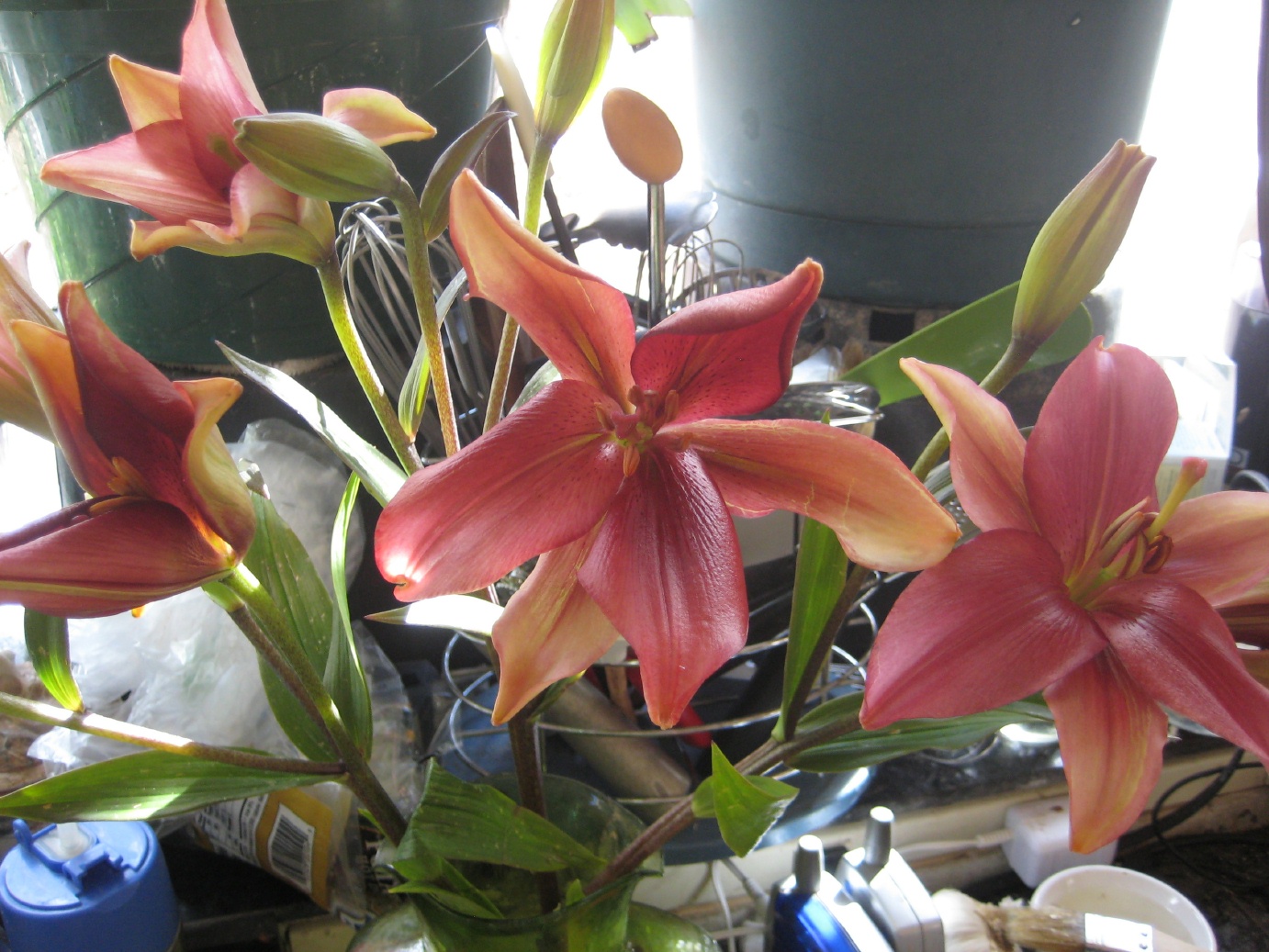
Lilies from my husband


It is a sunny spring morning here in the Chena Ridge Hills. True blue skies and not a cloud in sight from where I'm sitting. My house is amazingly silent and I'm not sure what to do with myself. Noah is having a sleepover at my folks, for which I feel somewhat guilty as he has a bad cold, sorry Mom! Avery has a cold too though and she is teething on top of that, so just having one fussy babe is plenty. At the moment though, she is down for her nap already along with her dad. I am sipping tea and eating cantaloupe and doing a very good job of being silent. I could wash dishes, put dishes away or cook something, but that would make way too much noise, so alas I am forced to sit and have some computer time, not enjoying myself at all....

The does are outside together for the first time since having their kids. The kids are in a pen together. They've probably worn themselves out by now and are sleeping in a big pile. Rose's weak little boy is still catching up to the rest of the kids. I took him away from his mom for an afternoon to feed him mother's milk in a drenching syringe. At the time he wasn't standing, sucking or swallowing. Now he is doing all of those but still needs assistance finding the teat. So every few hours I help him nurse and watch the other kids to make sure they are nursing. 

One of the biggest issues we have is that the kids prefer to nurse on the easiest (least full) side and quickly begin to favor whichever side they've drained. Then even after I come along and try and empty some of the pressure from the huge side, they are still going for whichever side they've nursed on the last few times. So we attempt to combat this by milking some of the heavy side so that it is similar in size as the other, then directing them towards that side, covering up the teat on the side we don't want them to suck on etc. Fortunately, this means that we get some milk, earlier than we would otherwise. I milked Rose and Xoe yesterday just enough to even out their heavy side, (they still looked about half full when I was finished) and we got a half a gallon of milk. At two weeks old we will begin putting the kids into one stall and after we milk their moms we will let them out for the day. This way we all get milk, the kids grow well and get to spend the days with their mom and sleep with their siblings and friends in a safe place at night.

This is the third kidding year (second for Xan) that these does have had and each year their udders are larger, more developed and therefor hold more milk. Once we start milking all three does every morning, I'm guessing we will be getting around three gallons of milk a day. Once their kids are sold, we then have the option to milk at night as well if we chose, which would give us another three gallons. If you drop them down to one milking a day they won't produce twice as much, but rather about the same amount per milking. So it comes down to time and or demand for milk. Do we want three gallons or six gallons a day? You get more bang for your buck, but it takes another hour (scooping grain, getting goats, cleaning udders, weighing milk, straining and jarring milk, washing pails and totes...) more than an hour if the kids are in tow. We will just have to see how our summer develops.

Last year Dustin was working ten hour days six days a week for a majority of the summer. He would get home, shower, eat dinner, then play with the kids while I did evening chores. Then they would all go to bed and I would stay up till eleven or one in the morning watering and working in the garden. Avery wasn't sleeping well at the time though, and often I would get summoned down to the house by a half asleep husband holding a crying baby and facing up the hill towards myself who would be scurrying around trying to water another row quickly. The last two summers I wasn't up for a night time milking, but this may be the year. 

We have hired our first farm apprentice! Welcome Becca! I am so excited about our summer together! B is going to be coming up to help five days a week for four to five hours a day. She will be feeding and watering all of the chickens and ducks, tossing hay and graining the goats, filling waterers, milking goats, processing milk and starting some basic cheeses. She may also help with separating cream and making butter. Other various farm chores on her list will be cleaning out coops, sheds, building compost piles, digging holes for fruit trees and mini duck ponds (think mud puddle), and planting, watering and harvesting the garden. In return we will be sharing eggs, milk, cheese and any extra veggies or other farm products in addition to paying her a monthly stipend. This arrangement works well for both of us as she is interested in farm experience, appreciates fresh real food and also wants to keep her other jobs. And I sure can use the help from a responsible and eager adult.

I have fantasized about starting some seedlings in the greenhouse or hoophouse in the ground, covered with windows, or in flats with domed tops, especially cool weather plants, cabbage, kale or cold hardy greens. I might get there yet but so far have opted for my usual seed starting rack indoors where I can closely keep an eye on everything. So far I have around forty tomato plants in three to four inch pots, peppers, flowers, broccoli, cabbage, cauliflower, a few greens and lots of culinary and medicinal herbs, some of which I've sowed multiple times to have it at different stages. I need to start squash and cucumbers next, followed by corn, sunflowers, nasturtiums and maybe beans. In most places you would direct seed these last things, but here our soil is so cold, they take a lot longer if ever to germinate. So if you can they will benefit from a couple weeks inside, before planting out. Noah wants to grow the corn in his garden as he did last year, however I hadn't taken his garden very seriously and had given him corn seed to push into the ground in mid- June. Well what do you know his corn ears got so close to ripening. So this year we will try a little harder.


We got an incubator in the mail this week and set some Amauracana eggs. We don't have any white eggs for me to put them up against. I did pull out our whitest looking eggs but this didn't end up being a very good photo to show off their lovely color. I'll try again sometime. When there is more light these eggs are much more colorful. We have purchased two batches of ten Amauracanas from two different small hatcheries over the past few springs. Unlike the equivalent that you would get from say Mcmurrays or Privett, these are show quality birds with excellent egg quality and color. We are down to our last two hens and a rooster so we are trying to keep things going. Both batches of chicks were heavy on the roosters. I had just started collecting eggs for hatching when our last hen (a blue hen) from the first chick batch died. I've got two of her eggs in here, I could tell them apart when they were fresh, but as they've sat a week I can't tell now. Our other hens are black and the rooster is blue so we should get a mix of black, splash and blue chicks, regardless of chick color, they should all lay lovely eggs, at least the hens will. We will set a couple batches of chicken eggs and if our sole Khaki Campbell duck starts laying again, I'll toss in some of those as well.

Speaking of ducks, we are expecting a shipment of sixty ducklings on Monday or Tuesday. Only twenty five are for us, but still, I will be picking them up and taking care of them for a day or so until the other ladies make it up to sort through them. I can feel mommy urges and baby lust flowing already at the thought of so many baby ducks to care for.

Xoe has turned out to be a great mom this time around. Can you imagine having three babies trying to nurse off you at the same time? Or three toddlers all running in different directions and trying to keep track of them all? Whew! Good job mama goats, I'm impressed.

Friday, March 20, 2009

The first Seed Starting of 09

This past weekend I began one of my favorite spring occupations; seed starting. I had purchased seed starting mix several weeks earlier. I had climbed up into our greenhouse and gathered together flats and various sizes of pots and I had even brought two flats in filled with pots so they would be warm when I was ready. I was waiting for the right moment. I could of course attempt to turn it into a mother son project during an afternoon while the babe was napping. But I knew that would result in a high blood pressure hour and a much bigger mess. And I was feeling a bit selfish, for now I wanted to enjoy carefully measuring out each little seed and putting it in the center of its pot, into its hole and gently pressing the soil down, all by myself without worrying about all the mishaps that would happen with the help of a three year old.

The timing was perfect, I had a window of time all to myself. I filled thre
e flats with soil. I planted forty four tomato seedlings, some into four inch pots and some in two inch. I planted mostly short season varieties such as Early Cascade, Early Wonder, Early Bush Girl and Oregon Spring. Then I planted a smaller number of heirloom longer season varieties, nothing that takes longer than eighty days. A few of my favorites are Sungold, Black Cherry, Orange Russian and Pink Accordian. Then I planted some herbs, some of which are slow to germinate and grow. The basil, thyme, parsley and cilantro will grow fast enough that I will be able to pinch the tops multiple times before planting. I will probably start multiple batches of basil and cilantro until early summer. I was surprised by how quickly everything germinated. I sowed a flat of tomatoes on Saturday and another one on Sunday, in addition to the flat of various herbs, some of which ( lavender, chamomile, oregano), I expected to take a couple weeks to germinate.

By Thursday almost everything had come up. Almost all of the tomatoes are up, some of the basil, thyme, chamomile, lavender, cilantro and even some oregano! Wow, I'm pretty impressed. In another week I will start some flowers and peppers, after that come broccoli and cabbage, a couple weeks later: squash and cucumbers and next I know it I'll be moving probably a dozen flats in and out daily to harden off in the spring sun on our back porch, and better yet up to the hoophouse for planting. So exciting!

This is a picture of Noah and I watering tomatoes, corn and herbs, all of which were started indoors and transplanted. Last spring we had dirt-work done to smooth out our hillside so it would be a gradual sloping garden. In previous summers we had gardened mostly in pots and a few constructed beds. Because we were waiting on dirtwork last summer, we didn't get hardly any plants into the ground until June 15th. Which is really late. The official planting out date here is June 1st and generally I get tomatoes in the ground by May 15th. and surround them with wall o waters or plant them in the greenhouse or other covered bed. This spring is very exciting because our garden is in place, so we should be able to start thawing out raised beds and planting some things (in the hoop-house) by May first.